
How Can Sign Fitting Improve Your Commercial Signage Installations?
May 13, 2026
Introduction
In the highly competitive B2B markets of Europe and North America, a meticulously executed signage installation is pivotal to brand visibility-suboptimal execution can significantly undermine it. Sign fittings serve as the critical interface between custom-designed graphics and secure, long-lasting mounting systems. This article examines how strategic investment in high-performance sign fitting solutions enhances durability, ensures regulatory compliance, and maximizes visual impact-thereby protecting brand reputation and delivering sustained return on investment (ROI).
Why Is Proper Sign Fitting Essential for B2B Clients?
1. Enhanced Durability
Premium-grade fittings exhibit superior resistance to corrosion, ultraviolet (UV) degradation, and mechanical stress. Materials such as stainless steel (grades 304 and 316), anodized aluminum, and engineered polymers significantly extend the service life of both indoor and outdoor signage installations.
2. Regulatory Compliance
Fittings are engineered to meet jurisdiction-specific building codes and structural requirements-including wind-load standards across the European Union and North America. Fire-rated components further ensure safety in public, commercial, and industrial environments.
3. Aesthetic Precision
Concealed bracketing systems and low-profile fasteners preserve clean architectural lines and reinforce brand consistency. Custom color-matched finishes enable seamless integration with façade materials and interior design schemes.
4. Installation Efficiency
Modular fitting systems and pre-assembled kits reduce on-site labor time and minimize installation errors. Universal mounting platforms accommodate diverse substrates-including glass, drywall, metal, and masonry-enhancing adaptability across project types.
Materials and Finishes
• Stainless Steel (AISI 304/316): Ideal for coastal, high-humidity, or chemically aggressive environments due to exceptional corrosion resistance.
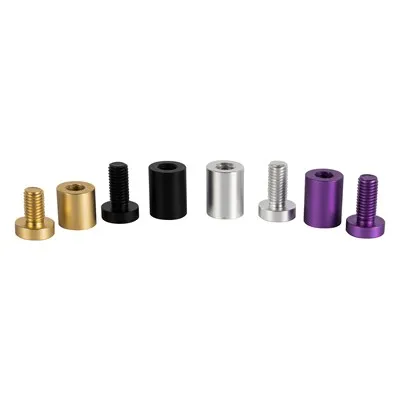
• Anodized Aluminum: Lightweight, non-magnetic, and highly corrosion-resistant; available in a broad spectrum of custom anodized colors.
• High-Performance Polymers (e.g., nylon, fiber-reinforced composites): Cost-efficient, electrically non-conductive, and suitable for interior applications requiring thermal or electrical isolation.
• Powder-Coated Finishes: Deliver exceptional color retention, uniformity, and resistance to abrasion and environmental exposure.
Best Practices for Installation
1. Comprehensive Site Assessment: Evaluate substrate integrity, structural load capacity, local wind-speed data, and environmental exposure conditions.
2. Precision Drilling and Anchoring: Employ calibrated templates and torque-controlled tools to guarantee accurate positioning and consistent clamping force.
3. Torque Verification and Quality Inspection: Confirm that all fasteners comply with manufacturer-specified torque values and installation tolerances.
4. Weatherproof Sealing: Integrate silicone gaskets, compression seals, or waterproof tapes to prevent moisture ingress behind signage panels.
5. Documentation and Certification: Provide clients with traceable compliance documentation-including test reports, CE/UL certifications, and tailored maintenance guidelines.
Implementation Considerations for European and North American Markets
• Regulatory Alignment
– Europe: Adherence to CE marking requirements and EN 13561 (performance standard for external signage).
– North America: Conformance with ASTM E330 (structural performance under uniform static air pressure) and UL 48 (safety standard for electric signs).
• Supply Chain Optimization
– Collaborate with certified regional distributors to mitigate import duties, customs delays, and extended lead times.
– Maintain inventory of dual-dimension fittings compatible with both metric and imperial mounting configurations.
• Value-Added Support Services
– Offer pre-assembly, kitting, and labeling services to streamline field deployment.
– Deliver technical training, digital installation guides, and on-demand engineering support to uphold installation quality and consistency.
Conclusion
For B2B organizations operating in Europe and North America, sign fitting transcends its functional role-it is a foundational element that directly influences safety, longevity, regulatory acceptance, and visual fidelity of every signage initiative. By selecting rigorously tested hardware, aligning with regional compliance frameworks, and partnering with technically proficient suppliers, stakeholders ensure installations that meet client expectations, satisfy regulatory authorities, and endure over time.
Elevate your next signage project with purpose-built sign fitting solutions-engineered for performance, reliability, and long-term peace of mind.